Fusion Core & Operator Console
KATANA RCWS
BAT-M Acoustic Array
Sleuthound Optical Head
Terawave RF Aperture

Every counter-drone system fails the same way: it relies on a single physical principle, and the adversary learns to defeat that principle. Radio-silent drones defeat RF. Night, haze and low contrast defeat optics. Terrain masking and clutter defeat radar at low altitude.
Gridbots Sentinel is built on the opposite premise. Three unrelated sensing domains — radio-frequency, electro-optical and acoustic — are stacked as overlapping shells around the protected asset. A threat that suppresses one layer walks directly into the next, and the handover between layers is continuous: there is no range at which the target is unobserved.
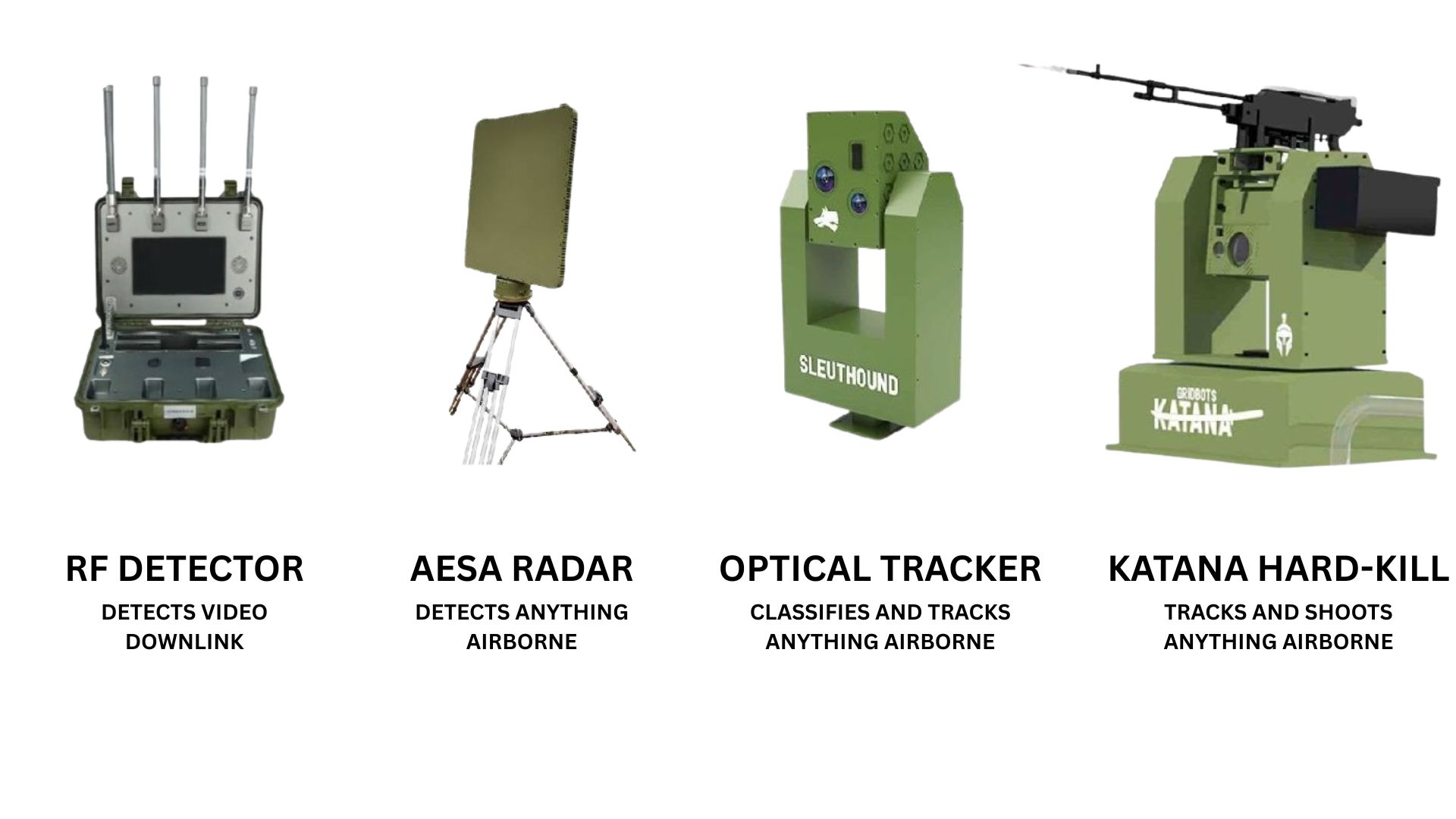
Detection alone is not defence. The fused track is passed as a slew-to-cue command to KATANA, the Gridbots stabilised remote weapon station, which acquires the target on its own EO/IR tracker, computes a lead-compensated firing solution and defeats it with a short, disciplined burst.
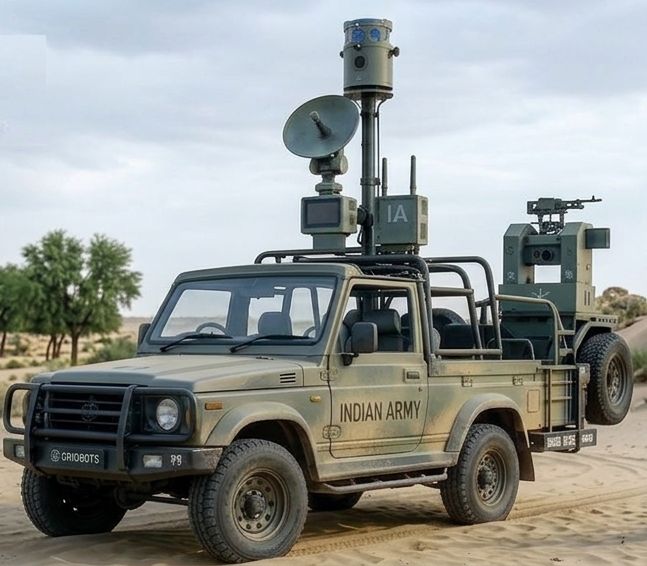
The complete sensing stack mounts on a single compact mast. The effector mounts alongside it, on the same vehicle, or on a separate node in a meshed network.
Where one layer's confidence decays, the next is already rising. The handover is engineered, not incidental — every layer reaches at least 20% beyond the point at which the next achieves reliable declaration.
Fig. 02 · Layer coverage & handover envelope

Fig. 03 · Track confidence vs range

Why three layers
| Adversary countermeasure | Layer that still sees it |
|---|---|
| Fibre-optic tethered FPV (zero RF emission) | EO/IR + Acoustic |
| Pre-programmed autonomous waypoint flight | EO/IR + Acoustic |
| Night, haze, low contrast, smoke obscuration | RF + Acoustic |
| Frequency hopping / encrypted datalink | RF (wideband) + EO/IR |
| Terrain-masked nap-of-the-earth ingress | Acoustic + EO/IR |
| Glide / motors-off terminal approach | EO/IR |
Engineered overlap. Each layer is specified to reach at least 20% beyond the point at which the next layer achieves reliable declaration. This deliberate redundancy is what allows Sentinel to hold a continuous track file on a target that is actively trying to break lock — and it is the reason a single-sensor countermeasure does not produce a gap in coverage.
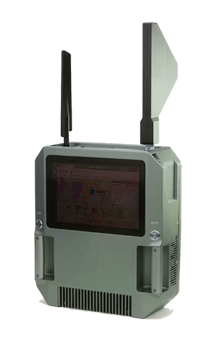

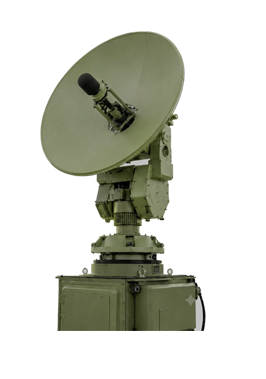
Wideband passive RF detector with coherent direction finding — the outermost shell, and the only layer that can locate the operator as well as the aircraft. Terawave listens. It never transmits, so it presents no emission for an adversary to detect, geolocate or home upon: a decisive advantage over radar-first architectures in contested electromagnetic environments.
The unit continuously sweeps a wide swathe of the spectrum for the characteristic signatures of unmanned aircraft: command uplinks, video downlinks, telemetry bursts and the timing structure of frequency-hopping control protocols. Signal classification runs against a maintained library of commercial, modified and military UAS emitters, and the library is field-updatable without factory return.
Coherent direction finding is what separates Terawave from simple spectrum alarms. The receiver chain preserves phase coherence across its aperture and resolves the bearing of the emitter directly from the wavefront — a true angular fix delivered within the first seconds of emission, not a proximity estimate derived from signal strength. That bearing is handed instantly to Layer 02, which slews to the indicated sector and begins optical search in a narrow arc rather than across the whole sky, collapsing acquisition time by an order of magnitude.
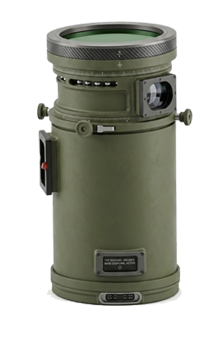
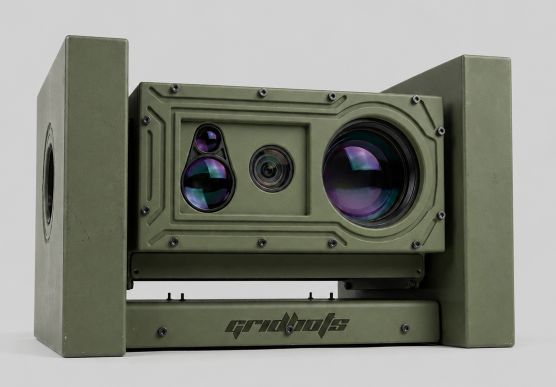
A continuously rotating multispectral scanner that turns the whole sky into a single refreshed image — and tells you what is actually flying in it. Sleuthound rotates without pause, building a complete hemispherical picture and refreshing it once per second. Nothing enters the volume unobserved, whether or not it is transmitting.
Three optical bands are carried on one head. NIR gives fine spatial detail and reads airframe geometry in daylight and starlight. SWIR cuts through haze, dust and thin smoke where visible imaging collapses, and remains effective in the difficult twilight bands. MWIR reads emitted heat, exposing motor and battery signatures against a cold sky at night and through obscurants entirely.
A drone that hides in one band is exposed in another. Fusing all three at the pixel level yields a signature far harder to defeat than any single-band imager, and provides the classification confidence needed to authorise a kinetic response. An on-board GPU performs detection, classification and angular localisation at the head — no video is shipped to a rear workstation and no decision waits on a network. Sleuthound resolves what a track actually is: rotary-wing UAS, fixed-wing UAS, bird, or manned aircraft.
Fig. 04 · Multispectral band complementarity
| Band | Primary contribution | Daylight | Night | Haze / dust / smoke |
|---|---|---|---|---|
| NIR | Airframe geometry, rotor form, fine detail | Excellent | Moderate | Limited |
| SWIR | Obscurant penetration, twilight continuity | Excellent | Strong | Excellent |
| MWIR | Motor / battery thermal signature, cold-sky contrast | Moderate | Excellent | Strong |
| FUSED | Combined signature — classification & declaration | Excellent | Excellent | Excellent |

The terminal layer. When a drone is close enough to matter, it is close enough to hear — and sound cannot be made stealthy. Inside 800 metres a multirotor is loud, and its noise is structured. Rotor blade passage produces a distinctive harmonic signature that no operator can suppress: the drone must move air to stay airborne, and moving air makes sound.
BAT-M derives from the combat-proven Gridbots BAT acoustic locator family, re-tuned from supersonic muzzle events to the low-frequency rotor domain. A calibrated three-dimensional microphone array samples the acoustic field continuously; digital signal processing extracts the rotor harmonic set from ambient clutter and resolves the source direction from the differential arrival of the wavefront across the array.
Because it is entirely passive and physically independent of both the electromagnetic and optical domains, BAT-M is immune to jamming, to RF silence, to darkness and to visual obscuration alike. It is the layer that holds the track when everything else has been degraded — and it covers precisely the band in which terminal engagement occurs, providing an independent, physics-diverse confirmation of a hostile track at the single most valuable moment in the engagement to have a second opinion.
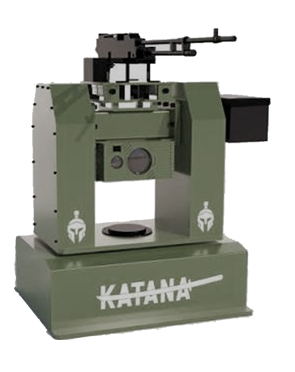

KATANA is among the most precise remote weapon stations built in India, proven on armoured platforms and at high-altitude forward posts. In the Sentinel architecture it is configured for the air-defence role with a 7.62 mm medium machine gun.
KATANA does not depend on the sensing stack to shoot. It carries its own real-time EO/IR tracker, so the cue from Layers 01–03 is only a starting bearing: the station slews onto the indicated sector, acquires the target independently on its own optics and locks. From that moment the firing solution is generated from the weapon's own line of sight, eliminating the parallax and latency errors that afflict systems slaved to a remote sensor.
Stabilisation holds the sight line steady against vehicle motion, wind loading and recoil, which makes engagement from a moving platform practical rather than theoretical. The ballistic solver continuously computes lead against the target's measured velocity vector so that rounds and drone arrive at the same point in space.
Engagement is deliberately economical: a controlled burst of four to five rounds, then reassess. Against a swarm this discipline is decisive — the prioritisation engine re-slews to the next-highest-threat track in under a second and repeats, sustaining a high engagement rate on a modest ammunition load.
The handovers are automatic; the authority is yours.
Fig. 05 · Fused cueing chain

The failure mode of multi-sensor counter-UAS systems is not blindness — it is noise. Three sensors reporting the same drone as three separate contacts is worse than one sensor reporting it correctly, because the operator must now resolve the ambiguity under time pressure.
The Sentinel fusion core associates detections across all three domains into a single track file before anything reaches the operator's screen. A drone detected on RF at 2,400 m, identified optically at 1,300 m and confirmed acoustically at 700 m appears throughout as one continuous track with a rising confidence value — never as a new contact.
Fusion also supplies something no single sensor can: independent corroboration. A track carried by two or three unrelated physics is qualitatively stronger evidence than a track carried by one, however good that one may be. Sentinel presents a corroboration state with every track — which domains currently hold it, and with what agreement — so that the decision to fire rests on visible, auditable evidence rather than on an opaque confidence percentage.
Engagement timeline · Nominal
KATANA engagement sequence
Battle damage assessment feeds the track file and re-cues automatically if the target survives.
| Threat class | Terawave · RF | Sleuthound · EO/IR | BAT-M · Acoustic | Sentinel response |
|---|---|---|---|---|
| Commercial quadcopterCOTS, radio-controlled | ● Primary | ● Primary | ● Primary | Detected at maximum range on emission; identified and defeated well outside the protected perimeter. |
| Fibre-optic FPVzero RF emission | ○ Blind | ● Primary | ● Primary | The threat class that defeats RF-only systems outright. Optical scan and acoustic array carry the full engagement. |
| Autonomous waypoint UASpre-programmed, no link | ○ Blind | ● Primary | ● Primary | No datalink to detect or jam. Sentinel engages on optical signature and rotor acoustics alone. |
| Night / obscured ingressdarkness, haze, smoke, dust | ● Primary | ● SWIR / MWIR | ● Primary | SWIR penetrates obscurants; MWIR reads thermal signature against cold sky. The acoustic layer is condition-independent. |
| Coordinated swarmsaturation from multiple vectors | ● Primary | ● Primary | ◑ Terminal | Full-sky 1 Hz scan holds all contacts simultaneously; the prioritisation engine sequences KATANA by threat value. |
| Weaponised payload UASmunition or dispersant carrier | ● Primary | ● Primary | ● Primary | Layered detection establishes a defended standoff so that engagement occurs before release altitude is reached. |
| ISR / surveillance dronepersistent standoff observation | ● Primary | ● Primary | ○ Out of band | Downlink bearing exposes both aircraft and ground control station; operator position is passed for interdiction. |
| EW / jammer-carrying UASspectrum-denial payload | ◑ Degraded | ● Primary | ● Primary | Jamming does not touch the optical or acoustic domains. Sentinel continues to track and engage through EM denial. |
| Low, terrain-masked ingressnap-of-the-earth approach | ● Primary | ◑ Line of sight | ● Primary | The profile that defeats radar horizon. RF and acoustic detection are unaffected by the absence of a clean skyline. |
● Primary — layer carries the track · ◑ Partial / terminal — contributes within a limited band · ○ Blind — no contribution from this domain
Fig. 06 · Architectural comparison
| Capability | Gridbots Sentinel | RF-only detector | Radar + jammer |
|---|---|---|---|
| Independent sensing domains | Three | One | Two (both EM) |
| Detects radio-silent drones | ✔ Yes | ✘ No | ◑ Radar only |
| Operates through EW / jamming | ✔ Yes | ✘ No | ✘ No |
| Emission footprint | Passive layers | Passive | Actively radiates |
| Bird / aircraft discrimination | ✔ Multispectral | ✘ None | ◑ Doppler only |
| Integral hard-kill | ✔ KATANA | ✘ None | ✘ Soft-kill only |
| Terminal-phase confirmation | ✔ Acoustic | ✘ None | ✘ None |
| Operator localisation | ✔ Coherent bearing | ◑ RSSI estimate | ✘ None |
| Indigenous design & support | ✔ 100% India | ◑ Varies | ◑ Varies |
All three sensing layers occupy a single compact mast, ordered so that each has the field of view its physics requires: the acoustic array uppermost and clear of ground reflection, the RF aperture beneath it with an unobstructed horizon, and the optical head at the level that gives the cleanest sky-line for its rotation.
Fusion compute and power conditioning sit in the base, keeping mass low and the mast slender. A single cable run carries data and power up the mast, so field replacement of any one sensor is a bolt-and-connector operation rather than a depot task.
KATANA mounts alongside the mast on the same platform, or on a separate node entirely — the cue is data, not a mechanical linkage, so sensing and effect can be physically separated where the tactical situation demands it.
The operator retains complete authority over every engagement decision. Sentinel presents the fused track picture, the corroboration state and a targeting recommendation — and takes no autonomous action whatsoever. Intended for peacetime deployments, mixed civil airspace and ROE-sensitive environments.
Detection, classification, track fusion and slew-to-cue proceed autonomously. A complete firing solution is prepared and presented for single-action authorisation. Response time collapses to seconds while human judgement remains in the loop on every kinetic effect.
Within a pre-authorised rule set and a geofenced engagement volume, Sentinel detects, classifies, prioritises and neutralises without operator intervention. Reserved for saturation scenarios in which threat tempo exceeds the human decision loop. Operator override is available at all times.
Sentinel is designed to be a sensor and effector node within a larger air-defence picture, not a closed island. Fused track data, engagement logs, classification imagery and system health telemetry are published over standard military datalinks to any compatible C2 node.
Equally important is what happens when that link fails. All classification, fusion and cueing execute on-mast, so a comms-denied Sentinel node continues to detect, decide and — within its authorised rule set — engage. Nothing in the kill chain requires a round trip to a rear headquarters.
After every burst the EO/IR tracker performs visual assessment and the result is written to the track file. If the target persists, the prioritisation engine re-cues automatically.
Every engagement is recorded in full: sensor corroboration state at the time of authorisation, the identity of the authorising operator, the firing solution, imagery before and after, and grid coordinates — a complete evidentiary record for post-action review, inquiry or prosecution.
| Model series | GRIDBOTS SENTINEL |
| Architecture | Layered and distributed — three sensing domains, one effector |
| Sensing physics | Electromagnetic (RF) · Photonic (EO/IR) · Acoustic |
| Azimuth coverage | 360° continuous, all layers |
| Track handling | Simultaneous multi-track, one fused track file per aircraft |
| Swarm handling | Full-sky simultaneous hold with threat-value prioritisation |
| Engagement modes | Manual / Assisted / Full Autonomous (ROE-gated, geofenced) |
| Cue-to-fire readiness | Under 2 seconds |
| Network topology | Single node or meshed multi-node |
| Autonomous endurance | Up to 24 hours |
| Detection envelope | 2–3 km nominal |
| Operating mode | Fully passive · zero emission |
| Localisation method | Coherent direction finding — phase-preserving receive chain |
| Signal classification | Field-updatable emitter library (commercial, modified, military) |
| Protocol handling | Command uplink, video downlink, telemetry, frequency hopping |
| Operator localisation | Yes — ground control station bearing-fixed separately |
| Output | Slew-to-cue sector to Layer 02 |
| Detection envelope | 1.5 km nominal |
| Spectral bands | NIR · SWIR · MWIR, pixel-level fused |
| Scan pattern | Continuous rotation, full hemispherical coverage |
| Refresh rate | 1 Hz full-sky |
| Processing | On-board GPU inference at the sensor head |
| Classification output | Rotary-wing UAS / fixed-wing UAS / bird / manned aircraft |
| RF dependency | None — detects radio-silent and fibre-optic drones |
| Localisation band | 800 m – 100 m |
| Sensor | Calibrated three-dimensional microphone array |
| Detection principle | Rotor blade-pass harmonic extraction via DSP |
| Solution type | Real-time bearing from differential wavefront arrival |
| Heritage | Gridbots BAT acoustic gunshot locator family |
| EW vulnerability | None — non-electromagnetic domain |
| Role | Terminal confirmation inside the weapon envelope |
| Weapon fit | 7.62 mm medium machine gun (air-defence configuration) |
| Engagement envelope | 1 km |
| Burst discipline | 4–5 rounds per engagement, then assess |
| Own sensor | Independent real-time EO/IR tracker |
| Stabilisation | 3-axis — shoot-on-the-move capable |
| Fire control | Continuous lead-compensated ballistic solver |
| Azimuth traverse | 360° |
| Re-engagement | Sub-second re-slew to next prioritised track |
| Assessment | Automatic EO/IR battle damage assessment and re-cue |
| Configuration | Single compact mast — sensors, compute and power conditioning |
| Deployment time | 15–20 minutes |
| Crew requirement | Two persons |
| Calibration | Automatic at boot — levelling, alignment and self-health check |
| Sensor servicing | Field hot-swap, bolt-and-connector |
| Effector placement | Co-sited or remote node |
| Vehicle mount | Light 4×4 through heavy truck chassis |
| Enclosure | Sealed, wide-temperature operation, high-humidity tolerance |
| Mechanical | MIL-STD vibration and shock envelopes, anti-vibration isolation |
| Electrical | EMI/EMC conformant, fused redundant power architecture |
Detailed performance figures, environmental qualification reports and interface control documents are released to qualified government and defence procurement authorities on request.
Gridbots Sentinel is designed, developed and manufactured in India. Every layer of the sensing stack, the fusion core and the KATANA effector originate from a domestic engineering base, under Make-in-India and Atmanirbhar Bharat defence-procurement directives.
This is not a labelling exercise. Domestic origin removes import licensing exposure, foreign technology-transfer restriction, currency risk and end-use veto from the programme entirely. Depot-level maintenance, spares and software sustainment all reside within India, and the source engineering team is reachable directly rather than through a foreign principal.
For large-scale procurement, Gridbots offers structured technology-transfer arrangements — design documentation, manufacturing process, test jigs and engineer training — supporting partner co-production and long-term self-reliance.
Standards & Certification
EMI / EMC Conformant MIL-STD Vibration & Shock Sealed Enclosures Wide-Temperature Operation High-Humidity Tolerance Fused Redundant Power Make in India Atmanirbhar Bharat · PILEngage the Gridbots defence solutions team for a technical briefing, a live-fire field demonstration, or a procurement discussion. Site-specific threat assessments and custom integration studies are available on request to qualified government and defence procurement authorities.
GET A QUOTE CONTACT US
Gridbots Technologies Pvt. Ltd. · Ahmedabad, Gujarat, India
+91-9924826584 · contact@gridbots.com
| Document reference | DOC-GBS-SENT-002 | Classification | Technical briefing |
| Revision | 2026.Q3 · Issue 05 | Distribution | Authorised defence review |
| Product designation | GRIDBOTS SENTINEL | Language | EN · translations available |