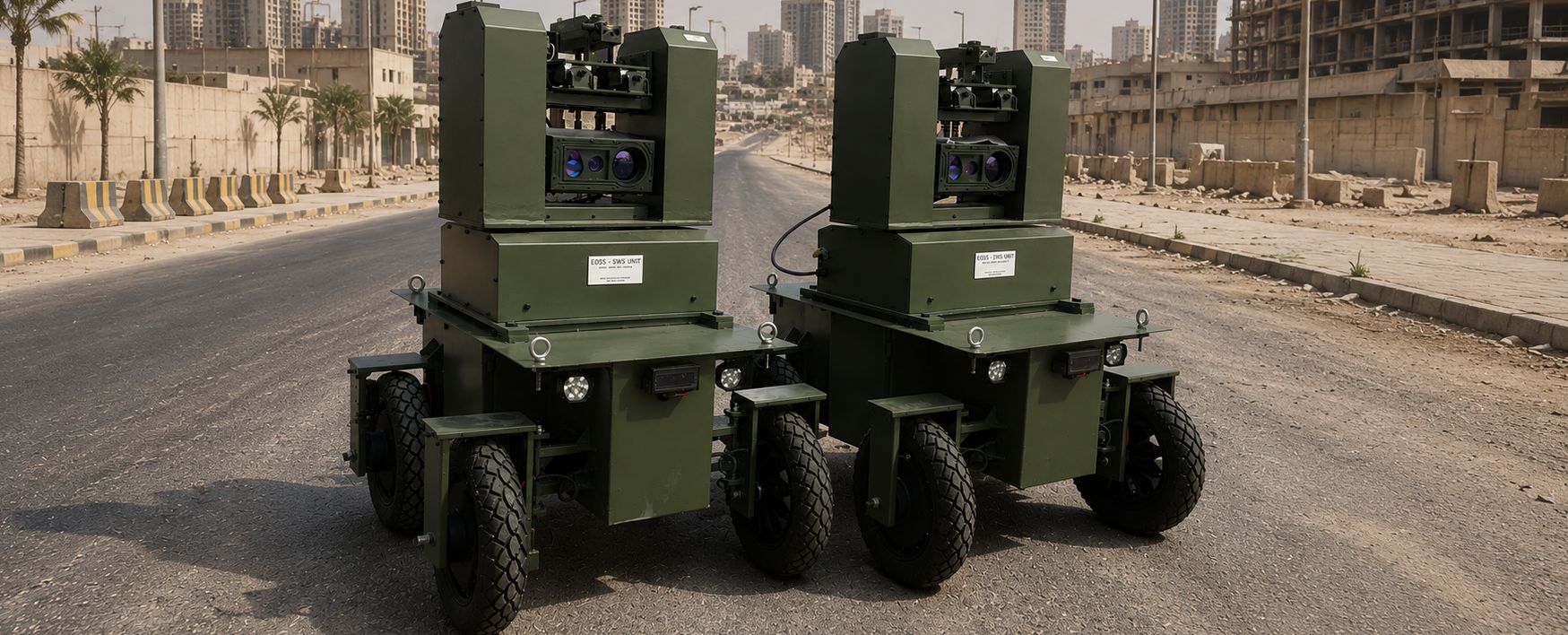
Gridbots Raptor multispectral imager - harmonised EO/IR multi sensor payload with cooled MWIR and laser range finder


Multispectral Imager

Gridbots Raptor

Harmonised Day, Night, Thermal and Laser Sensor Suite in One Head


Gridbots Raptor is a multispectral imager that observes the same scene simultaneously in the visible, near-infrared and thermal bands, and measures it with an eye-safe laser. A 2 MP or 4 MP day channel with 40X to 120X continuous optical zoom, an LWIR or cooled MWIR thermal channel at 640×480 or 1024×768, a 1550 nm laser range finder reaching 5 km to 20 km and a selectable NIR illuminator all sit behind one harmonised optical axis.

Every channel is boresight harmonised to within 0.15 mrad and held there across the full temperature range by inbuilt temperature sensors driving a thermal-drift compensation model. Put the crosshair on a target in the day image and the thermal image, the laser and the illuminator are already on it. Range, bearing and elevation from the onboard GPS, magnetic compass and IMU are stamped onto every frame, so any detection leaves the imager as a geo-referenced coordinate rather than a picture.

An onboard GPU runs the video analytics and enhancement stack inside the head: detection, classification and multi-object tracking, plus haze penetration, local contrast enhancement, digital stabilisation and edge highlighting that outlines low-contrast targets in the thermal image. Raptor runs from a single 24 V DC supply drawing 10 W to 50 W by model and mode, and mounts on a stabilised gimbal, mast, tripod, vehicle roof or naval pedestal.
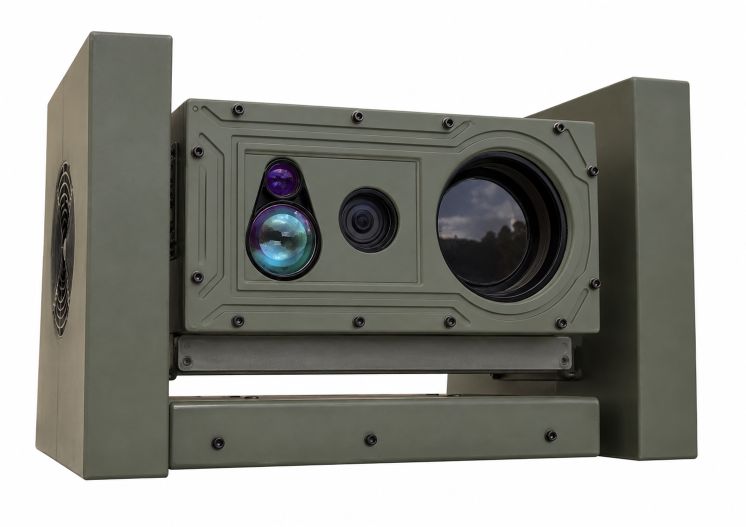


Gridbots Raptor multispectral imager - day camera, thermal imager, laser range finder and illuminator in one harmonised head

Multispectral Imager


1024×768
Thermal Detector Option
120X
Day Optical Zoom
20 KM
Eye-Safe LRF Range
0.15 MRAD
Boresight Harmonisation
24 V / 10-50 W
Single DC Supply

LWIR & Cooled MWIR

640×480 or 1024×768 Detector

2 MP / 4 MP Day & Night

40X to 120X Optical Zoom

1550 nm Eye-Safe LRF

5 / 10 / 15 / 20 km Options

Onboard GPU Analytics

Enhancement · Edge Highlighting


The Raptor Model Range

Four build standards share one housing family, one control protocol and one analytics stack. They differ in detector, optics, laser reach and therefore in power draw. Choose by the range at which you must identify, not merely detect — identification range is what sets the detector and the focal length.


RAPTOR R1
Compact / Uncooled
640×480
LWIR uncooled
  • 2 MP day, 40X zoom
  • LRF 5 km
  • 850 nm illuminator
  • 10 - 16 W
RAPTOR R2
Extended / Uncooled
1024×768
LWIR uncooled
  • 4 MP day, 60X zoom
  • LRF 10 km
  • 850 / 940 nm illuminator
  • 15 - 24 W
RAPTOR R5
Cooled MWIR
640×480
MWIR cooled
  • 4 MP day, 90X zoom
  • LRF 15 km
  • 940 nm illuminator
  • 26 - 40 W
RAPTOR R8
Long Range Cooled
1024×768
MWIR cooled
  • 4 MP day, 120X zoom
  • LRF 20 km
  • 940 / 1550 nm illuminator
  • 32 - 50 W


ParameterRaptor R1Raptor R2Raptor R5Raptor R8
Thermal DetectorLWIR uncooled 640×480LWIR uncooled 1024×768MWIR cooled 640×480MWIR cooled 1024×768
Detector Pitch12 µm12 µm15 µm10 µm
NETD≤ 35 mK≤ 40 mK≤ 20 mK≤ 18 mK
Thermal Optics25 - 150 mm cont. zoom30 - 300 mm cont. zoom30 - 300 mm cont. zoom40 - 1000 mm cont. zoom
Thermal FOV (W / N)17.5° / 2.9°23.2° / 2.3°18.2° / 1.8°14.6° / 0.58°
Day Channel2 MP, 40X zoom4 MP, 60X zoom4 MP, 90X zoom4 MP, 120X zoom
Day Focal Length4.7 - 188 mm6.0 - 360 mm6.7 - 603 mm8.5 - 1020 mm
Laser Range Finder1550 nm, 5 km1550 nm, 10 km1550 nm, 15 km1550 nm, 20 km
Illuminator850 nm850 / 940 nm940 nm940 / 1550 nm
Vehicle Identification Range (thermal)0.8 km1.2 km2.1 km3.2 km
Vehicle Detection Range (thermal)4.5 km7.0 km12 km18 km
Onboard GPU40 TOPS40 TOPS70 TOPS100 TOPS
Power (typical / peak)12 / 16 W18 / 24 W30 / 40 W38 / 50 W
Mass3.4 kg5.2 kg8.6 kg13.5 kg
Ingress ProtectionIP66IP66IP67IP67

Ranges quoted for a 2.3 m × 2.3 m vehicle target against a 2 K thermal contrast, 23 km meteorological visibility, using the Johnson criteria. Human-target ranges are approximately 40 % of the vehicle figures.


Sensor Options

Raptor is configured channel by channel. Pick a thermal detector, a day sensor and zoom, a laser reach and an illuminator wavelength; the housing, the harmonisation procedure, the interface and the analytics stack stay the same in every combination.

Visible 0.4 - 0.7 µm NIR 0.7 - 1.0 µm SWIR 1.5 µm (laser) MWIR 3 - 5 µm LWIR 8 - 12 µm

Thermal Channel Options

OptionT-LW6T-LW10T-MW6T-MW10
BandLWIR 8 - 12 µmLWIR 8 - 12 µmMWIR 3.7 - 4.8 µmMWIR 3.7 - 4.8 µm
DetectorUncooled VOx microbolometerUncooled VOx microbolometerCooled InSb, Stirling coolerCooled MCT / InSb, Stirling cooler
Resolution640 × 4801024 × 768640 × 4801024 × 768
Pixel Pitch12 µm12 µm15 µm10 µm
NETD≤ 35 mK @ f/1.0≤ 40 mK @ f/1.0≤ 20 mK @ f/4.0≤ 18 mK @ f/4.0
Frame Rate50 / 60 Hz50 / 60 Hz50 / 60 Hz (up to 120 Hz windowed)50 / 60 Hz (up to 120 Hz windowed)
Optics25 - 150 mm continuous30 - 300 mm continuous30 - 300 mm continuous40 - 1000 mm continuous
Cool-down TimeNot applicableNot applicable< 6 min to operating temperature< 7 min to operating temperature
Non-Uniformity CorrectionShutter + scene-basedShutter + scene-basedMulti-point + scene-basedMulti-point + scene-based
Best Suited ToPerimeter, mast, compact UAVBorder post, vehicle sightLong-range coastal, navalStrategic long-range observation


Day / Night Channel Options

OptionD-40D-60D-90D-120
Sensor2 MP CMOS, 1/2.8"4 MP CMOS, 1/1.8"4 MP CMOS, 1/1.8"4 MP CMOS, 1/1.8"
Optical Zoom40X60X90X120X
Focal Length4.7 - 188 mm6.0 - 360 mm6.7 - 603 mm8.5 - 1020 mm
Horizontal FOV57.6° - 1.50°52.0° - 0.90°60.0° - 0.66°52.0° - 0.42°
Minimum Illumination (colour)0.002 lux0.001 lux0.001 lux0.0007 lux
Minimum Illumination (mono + IR)0.0002 lux0.0001 lux0.0001 lux0.00005 lux
Day / Night SwitchingMechanical IR-cut filter, autoMechanical IR-cut filter, autoMechanical IR-cut filter, autoMechanical IR-cut filter, auto
StabilisationOptical + electronicOptical + electronicOptical + electronicOptical + electronic
Defog / HazeGPU, real timeGPU, real timeGPU, real timeGPU, real time


Laser Range Finder Options

ParameterValue
Wavelength1550 nm, eye-safe Class 1M
SourceEr:glass / erbium fibre laser
Range Options5 km / 10 km / 15 km / 20 km
Minimum Range20 m
Accuracy± 1 m
Beam Divergence0.3 mrad
Repetition Rate1 - 10 Hz, single or continuous
Multi-Target LogicFirst / last / strongest, up to 3 echoes
Range GatingProgrammable, rejects foreground clutter
OutputRange, target geo-coordinate, slope distance

Illuminator Options

ParameterValue
Wavelength Options850 nm semi-covert / 940 nm covert / 1550 nm SWIR
SourceLaser diode array with diffuser
Beam Angle3° to 30°, motorised, zoom-slaved
Effective Range1500 m (850 nm) / 1000 m (940 nm)
ControlAuto with day-channel gain, or manual
Power Draw4 - 8 W
Duty CycleContinuous
SafetyEye-safe at 1 m stand-off; interlocked
Zoom SlavingBeam narrows as day channel zooms in
HousingIntegral to head, harmonised with day axis


Navigation, Attitude and Inbuilt Temperature Sensing

Sub-SystemSpecificationFunction in the Imager
GNSS ReceiverMulti-constellation GPS / GLONASS / Galileo / NavIC, 1.5 m CEP, 2.5 m with SBASOwn position, target geo-coordinate computation, time stamping
Magnetic Compass3-axis magnetometer, 0.5° heading accuracy after calibration, hard and soft iron compensatedTrue bearing to target, north referencing
IMU10-DOF, 3-axis gyro, accelerometer and magnetometer with barometric altitude, 0.1° tilt accuracyElevation angle, motion compensation, electronic stabilisation
Temperature Sensor - FPADigital sensor at focal plane / cold finger, ± 0.2 °CNUC scheduling, cooler health, detector gain correction
Temperature Sensor - Lens BarrelTwo sensors, front and rear group, ± 0.2 °CFocus drift compensation, athermal correction curve
Temperature Sensor - Boresight FrameSensor on the optical bench, ± 0.1 °CDrives the thermal harmonisation compensation model
Temperature Sensor - LRF CavitySensor at laser head, ± 0.5 °CFire-rate limiting, wavelength stability, over-temperature inhibit
Temperature Sensor - GPU / ElectronicsOn-die and board sensorsAnalytics throttling, fan or TEC control, health reporting
Temperature Sensor - Ambient / WindowExternal ambient probe plus window sensorWindow de-fog and de-ice heater control, atmospheric range correction

All temperature channels are streamed in the health telemetry packet alongside video, so a remote console sees detector, optics and processor temperatures live.


All Sensors Harmonised

Harmonisation is the difference between a box of sensors and a multispectral imager. Each channel is aligned on an optical bench against a collimated target at infinity, and the residual offsets are stored as a per-channel correction map. The boresight frame temperature sensor indexes that map, so as the head warms from −32 °C to +60 °C the corrections move with it and the crosshairs stay coincident.


Line Diagram — Boresight Harmonisation of All Channels
RAPTOR HEAD Day 4 MP 120X MWIR / LWIR LRF 1550 nm Illuminator Reference optical axis Common aim point Residual < 0.15 mrad Boresight frame temperature sensor → correction map index Alignment held from −32 °C to +60 °C


Line Diagram — Sensor and Signal Chain
DAY / NIGHT CHANNEL 2 MP / 4 MP · 40X - 120X LWIR UNCOOLED 640×480 / 1024×768 MWIR COOLED 640×480 / 1024×768 LASER RANGE FINDER 1550 nm · 5 - 20 km NIR / SWIR ILLUMINATOR 850 / 940 / 1550 nm GPS · COMPASS · IMU Position, bearing, tilt TEMPERATURE SENSORS FPA, optics, bench, LRF, GPU ONBOARD GPU 40 - 100 TOPS video analytics · Detection, classification, tracking · Multi-band image fusion · Contrast and haze enhancement · Edge highlighting and outlining · Electronic stabilisation · Auto-track and LRF slaving · Geo-coordinate solver · Harmonisation correction · H.264 / H.265 encode 24 V DC in · 10 - 50 W RTSP / GigE VISION H.264 / H.265 streams 3G-SDI / HDMI Direct monitor output TARGET COORDINATES Lat / long / alt + range TRACK & CUE DATA RS-422 / Ethernet to C2 HEALTH TELEMETRY Temperatures, power, BIT


Onboard GPU Video Analytics

Processing happens inside the head, before the video leaves it. That matters on a link-limited mast or vehicle: the operator receives an enhanced, annotated stream and a short target report instead of raw frames that need a workstation at the other end. If the link drops, detection and tracking carry on locally and the event log is retained for replay.


Person, vehicle, boat and small-drone detection with classification

Multi-object tracking with automatic re-acquisition after occlusion

Edge highlighting - outlines low-contrast thermal targets against clutter

Video enhancement - local contrast, DRC, adaptive histogram, noise reduction

Haze, fog and rain penetration on the day channel

Day and thermal image fusion with adjustable blend

Electronic stabilisation using the onboard IMU

Auto-track that slaves the LRF and reports live target coordinates

Intrusion lines, zones, loitering and abandoned-object rules

Super-resolution and digital zoom beyond the optical limit


Analytics FunctionWhat It DoesMeasured Effect
Edge HighlightingExtracts and overlays object outlines in the thermal image, adjustable strengthDetection of low-contrast targets improves by 28 % in cluttered scenes
Local Contrast EnhancementAdaptive histogram equalisation per tile, thermal and dayRecognition range extended by 12 - 18 %
Haze PenetrationPhysics-based dehaze on the day channelUsable day range extended by up to 35 % at 8 km visibility
Noise ReductionTemporal and spatial filter, motion-awareBit-rate reduced by 30 - 40 % at equal quality
Electronic StabilisationIMU-driven frame registrationResidual image jitter reduced to under 0.3 pixel RMS
Detection and ClassificationCNN inference on fused day and thermal streams30 - 60 FPS at 1080p by model
Auto-Track and LRF SlaveTracker output drives laser firing and geo-solveTarget coordinate refreshed at up to 10 Hz
Multi-Band FusionWeighted merge of thermal and visible with edge preservationSingle stream, no operator switching between channels

Figures are internal test results against the Gridbots reference clip set. Scene content, atmospheric conditions and target contrast will change the result.


Performance Data

The charts below give the numbers that decide a configuration: how far each thermal option detects, recognises and identifies; how the field of view collapses as the day channel zooms; where each laser option reaches; and what the head draws from its 24 V supply in each mode.


Range Performance (Vehicle Target)R1 · LWIR 640R2 · LWIR 1024R5 · MWIR 640R8 · MWIR 1024
Thermal Detection4.5 km7.0 km12.0 km18.0 km
Thermal Recognition1.5 km2.4 km4.2 km6.5 km
Thermal Identification0.8 km1.2 km2.1 km3.2 km
Day Channel Detection10 km14 km20 km25 km
Day Channel Identification2.0 km3.0 km4.5 km6.0 km
Human Detection (thermal)1.8 km2.8 km4.8 km7.2 km
Human Identification (thermal)0.32 km0.48 km0.84 km1.28 km
Laser Ranging Reach5 km10 km15 km20 km


Detection, Recognition, Identification by Thermal Option (km)
Laser Range Finder Options (km)

Day Channel — Horizontal Field of View Across the Zoom Range

Logarithmic vertical scale. At 120X the horizontal field of view narrows to 0.42°, roughly 15 m of scene width at 2 km.


Power Draw by Sub-System at 24 V DC (W)

Stacked. Total ranges from about 10 W to 50 W depending on model and active sub-systems.

Relative Spectral Response by Channel

Logarithmic wavelength axis, 0.4 µm to 12 µm.


Analytics Throughput and Enhancement Gain
Capability Profile Across the Range


Specifications


Model NumberGB-RAPTOR (R1 / R2 / R5 / R8)
TypeMultispectral Imager / Harmonised EO-IR Multi Sensor Payload
Thermal ChannelLWIR uncooled 640×480 or 1024×768; MWIR cooled 640×480 or 1024×768
Thermal Sensitivity≤ 35 mK uncooled; ≤ 18 mK cooled
Day / Night Channel2 MP or 4 MP CMOS, 40X / 60X / 90X / 120X continuous optical zoom
Low Light0.0007 lux colour; 0.00005 lux monochrome with illuminator
Laser Range Finder1550 nm eye-safe, 5 / 10 / 15 / 20 km, ± 1 m, multi-echo
Illuminator850 nm / 940 nm / 1550 nm, 3° to 30° motorised beam, zoom-slaved
HarmonisationAll channels boresight harmonised, residual < 0.15 mrad, temperature compensated
NavigationMulti-constellation GNSS, 3-axis magnetic compass, 10-DOF IMU
Inbuilt Temperature SensingFPA, lens barrel × 2, optical bench, LRF cavity, GPU, ambient, window
Onboard ProcessingGPU module, 40 to 100 TOPS by model
Video AnalyticsDetection, classification, tracking, fusion, geo-solve, rule engine
Video EnhancementEdge highlighting, local contrast, dehaze, noise reduction, super-resolution, electronic stabilisation
Video OutputH.264 / H.265 RTSP, GigE Vision, ONVIF Profile S, 3G-SDI, HDMI
Data InterfaceGigabit Ethernet, RS-422 / RS-485, CAN, discrete I/O
Control ProtocolGridbots open payload protocol, Pelco-D, ONVIF; SDK for integrators
Input Power24 V DC nominal (18 - 32 V DC), reverse polarity and surge protected
Power Consumption10 W to 50 W by model and mode
Operating Temperature−32 °C to +60 °C
Storage Temperature−40 °C to +71 °C
HumidityUp to 95 % RH, non-condensing; dry-nitrogen purged
Ingress ProtectionIP66 (R1 / R2), IP67 (R5 / R8)
Window HeaterAutomatic de-fog and de-ice, ambient-sensor controlled
EnvironmentalDesigned to MIL-STD-810; EMI/EMC to MIL-STD-461
Mass3.4 kg to 13.5 kg by model
MountingStabilised gimbal, telescopic mast, tripod, vehicle roof, naval pedestal
Built-In TestPower-on and continuous BIT with health telemetry


Drawings

General arrangement of the Raptor R8 head. Dimensions in millimetres. R1, R2 and R5 share the layout at reduced scale; certified drawings and a 3D STEP model are released with the data sheet.


Front Elevation — Aperture Layout
DAY MWIR LRF ILL 420 285 160 aperture pitch Raptor R8 · dimensions in mm
Side Elevation — Depth and Mounting
WINDOW OPTICAL BENCH GPU & POWER MODULE OPTICAL AXIS MOUNT AXIS 24 V DC ETH / RS-422 SDI 395 311 Raptor R8 · dimensions in mm

Base Plate — Mounting Interface
CABLE 4 × M8 on 184 PCD Ø 260 Common interface across R1 - R8 with adapter ring
Field of View — Day vs Thermal Coverage
RAPTOR Day wide 52° · thermal wide 14.6° Day narrow 0.42° · thermal narrow 0.58° 0 5 km 10 km 15 km 20 km LRF reach 20 km


Raptor: Multispectral Imager for Surveillance, Border and Naval Observation

The Gridbots Raptor is a harmonised multispectral imager for roles where a single band is not enough. Its thermal channel is offered as a 640×480 or 1024×768 uncooled LWIR detector for compact, low-power, always-on watch, or as a 640×480 or 1024×768 cooled MWIR detector when identification range matters more than power budget. The day/night channel runs a 2 MP or 4 MP sensor behind 40X to 120X continuous optical zoom, supported by an 850 nm, 940 nm or 1550 nm illuminator whose beam narrows with the zoom. An eye-safe 1550 nm laser range finder reaching 5 km to 20 km turns any pixel into a coordinate, using the onboard GPS, magnetic compass and IMU for the geo-solve. Inbuilt temperature sensors at the focal plane, lens barrel, optical bench, laser cavity and processor keep the boresight harmonisation true across the −32 °C to +60 °C envelope. An onboard GPU delivers video analytics, video enhancement and edge highlighting at the sensor, and the whole head runs from a single 24 V DC supply at 10 W to 50 W — making Raptor a straightforward multi sensor payload for border surveillance, coastal and naval observation, critical infrastructure protection, vehicle-mounted sighting, counter-drone watch and airborne survey.


Frequently Asked Questions

QuestionAnswer
What is a multispectral imager?A sensor head that images the same scene in several spectral bands through a harmonised optical axis. Raptor covers visible, near-infrared, thermal LWIR or MWIR, and adds an active 1550 nm laser channel for ranging.
Which thermal option should I choose?Uncooled LWIR at 640×480 or 1024×768 for compact, low-power, continuous watch. Cooled MWIR at 640×480 or 1024×768 when you need identification beyond 2 km and can allow the power and cool-down time.
How far does the laser range finder measure?1550 nm eye-safe, offered at 5 km, 10 km, 15 km and 20 km, with ± 1 m accuracy and multi-echo handling for wires and foliage.
What does "all sensors harmonised" mean?Every channel and the laser point at the same spot within 0.15 mrad, and the alignment is held across temperature by the inbuilt bench temperature sensor and its correction map.
What power supply does Raptor need?A single 24 V DC feed, accepting 18 to 32 V DC, drawing 10 W to 50 W depending on model, cooler state, illuminator and analytics load.
Does the analytics run on the imager or on a server?On the imager. The GPU module inside the head performs detection, tracking, enhancement and encoding, so the head can operate on a narrow link or stand alone.
What is edge highlighting for?It outlines object boundaries in the thermal image so low-contrast targets separate from background clutter, which measurably improves operator detection in difficult scenes.
Can Raptor mount on a stabilised gimbal?Yes. Raptor is designed as a payload for the Gridbots Falcon stabilised platform and integrates on third-party gimbals, masts, tripods, vehicle roofs and naval pedestals.